

For many Latino contractors in the DMV area (Washington, DC, Maryland, and Virginia), starting their own construction business is the natural next step after years of hands-on experience.
The work is there, demand is steady, and opportunities are real. Still, one question keeps coming up again and again: How much money do I really need to start my construction business in the United States?
The truth is, there’s no single answer. Costs vary depending on the state, the type of license, the size of the business, and how formal you want to be from the start. What is certain is that many contractors jump in without a clear plan and end up spending more money fixing mistakes than they would have if they had done things right from the beginning.
In this article, we break down the real estimated costs in the DMV, explain how to build a smart budget, and highlight key decisions that can make the difference between a business that barely survives and one that truly grows.
Mandatory Startup Costs (Business Registration & Legal Structure)
Before making any income, every business needs a legal foundation.
Business Registration and EIN
Estimated costs:
- LLC or Corporation registration: $150 – $500
- Registered Agent (if required): $100 – $300 per year
- EIN (IRS): Free
Practical tip:
Choosing the right legal structure from the start makes it easier to open bank accounts, obtain insurance, and apply for licenses. Avoid registering your business without understanding the tax and legal implications.
At HDS Biz Solutions, we help you register your business the right way from day one, avoiding mistakes that later cost time and money.
Contractor Licenses: A Cost That Depends on Many Factors
Lorem ipsum dolor sit amet, consectetur adipiscing elit. Ut elit tellus, luctus nec ullamcorper mattis, pulvinar dapibus leo.
Licensing rules are not the same in every state, and not all licenses allow you to do the same type of work.
Estimated costs:
- License application: $200 – $600
- Exams: $100 – $300
- Renewals: $100 – $300
- Required courses (depending on license): $300 – $800
Not all licenses allow the same project size or type of work. Getting the wrong license can limit your growth or lead to fines and penalties.
We provide clear guidance to help you identify and obtain the correct license based on your situation in the following states:
- Maryland
- Washington, DC
- Virginia
- New Jersey
- Pennsylvania
- West Virginia
- Delaware
Insurance and Business Protection
Before thinking about growth, hiring employees, or taking on larger projects, there’s one thing every contractor must understand: insurance is not optional in practice—and in many cases, it’s also required by law.
Some contractors start without coverage to “save money,” but the reality is that working without insurance exposes both the business and the owner to serious financial risk.
In many states, certain types of insurance are legally required, especially for residential work, commercial projects, or when you have employees. On top of that, most clients, builders, and general contractors will not hire you if you don’t have active insurance. Even when the law doesn’t strictly require it, the market does.
Common Types of Insurance (Estimated Costs)
- General Liability Insurance: $800 – $2,000 per year
- Workers’ Compensation (if you have employees): $1,500 – $3,500
Bond (when required): $100 – $500
Equipment, Tools, and Operating Expenses
You don’t need to buy everything at once—but you do need a plan.
Estimated costs:
- Basic tools: $2,000 – $5,000
- Work vehicle (used): $5,000 – $15,000
- Monthly operating expenses: $300 – $600
Start with the essentials and avoid getting into debt for tools you won’t use often. Renting equipment or buying used can be a smart strategy in the early stages.
Training: Investing to Grow
Many contractors believe field experience alone is enough to grow a construction business. While experience is essential, it’s not always enough to compete, scale, and stay profitable long term. Proper training makes the difference between working hard and working smart.
Investing in training helps you make better decisions, reduce costly mistakes, and understand the business side beyond the job site. With solid knowledge in key areas, contractors can create more accurate estimates, avoid code and compliance issues, and communicate more effectively with clients, inspectors, and other professionals.
Training also builds confidence and professionalism—two factors that directly affect how clients perceive you and your ability to secure better-paying projects. A trained contractor doesn’t just do the work; they plan, estimate, negotiate, and protect their business.
Training is not a one-time thing. Markets, regulations, and standards change. Staying up to date is one of the best ways to remain competitive.
At HDS Biz Solutions, we offer training courses in essential areas such as estimating, building codes, blueprint reading, and more—designed for contractors who want to grow on solid foundations.
Marketing and Visibility
Having construction experience does not guarantee that clients will find you. In an increasingly competitive market, visibility is just as important as quality work. A business that doesn’t clearly and professionally present itself often loses opportunities to those that do.
Marketing is not just advertising. It includes having a clear visual identity, a simple but professional online presence, and well-set-up profiles on platforms where clients search for services. These elements help build trust, credibility, and recognition—often before the first contact.
For a new construction business, an initial marketing investment of $1,200 to $3,000 is usually enough to cover a solid foundation: basic branding, online presence, and an initial push to get noticed. This range may vary depending on location, focus, and business goals.
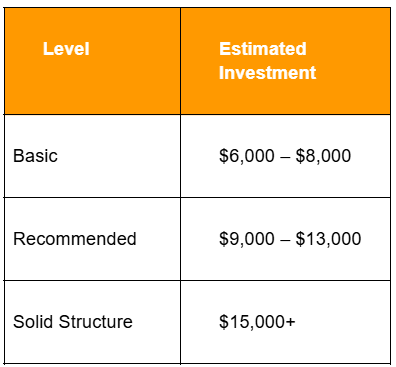
Estimated Initial Budget (Approximate Values)
All amounts vary depending on state, type of business, and planning.
Common Mistakes to Avoid
- Not registering your business
- Starting without a license or with the wrong one
- Not investing in training
- Working without insurance
- Mixing personal and business finances
- Failing to plan for growth
Fixing these mistakes almost always costs more than doing things right from the beginning.
Conclusion: Starting with Clarity Means Moving Forward with Confidence
Starting a construction business in the U.S. in 2026 isn’t just about having money—it’s about knowing how to use it strategically. With proper planning, the right guidance, and ongoing training, building a strong and sustainable business is absolutely possible.
Want to know exactly how much you need and how to start based on your situation?
Contact us for personalized guidance on:
- Business registration
- Contractor licensing
- Key training courses
- Structuring your business from scratch